
Inside one creator’s approach to pushing Captivate further

At first glance, the broadcast graphics coming out of Keene State College look like they belong on a national network. Clean motion. Confident pacing. Purpose-built animations. GPU-accelerated transitions. The kind of polish you expect from Fox or ESPN — not a Division III athletics program. But that’s exactly the point.
Behind these broadcasts is one creator who has unlocked the depth of NewBlue Captivate Sport by fully leveraging the power of the Designer, scaling graphics naturally from collegiate athletics to ESPN-ready productions.
What started as an experiment quickly turned into a foundation. When Ryan Hearn, Sports Information Assistant at Keene State College, first opened Captivate, his focus wasn’t on flashy results — it was on understanding what the platform and Designer made possible. How layers render in real time. How animation timelines interact. How data sources bind to graphic elements. How to design efficiently for live playout. That groundwork has paid off.
That foundation made everything else possible.
“The secret has been laying the groundwork over time, starting with learning the graphics—and there’s no question the graphics add a huge layer to the broadcast.”
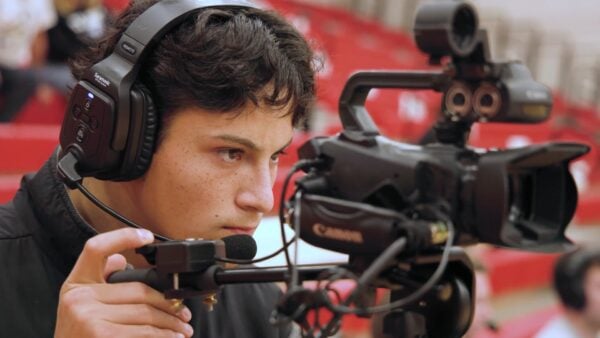
Today, Keene State’s live productions are complex, multi-camera operations.
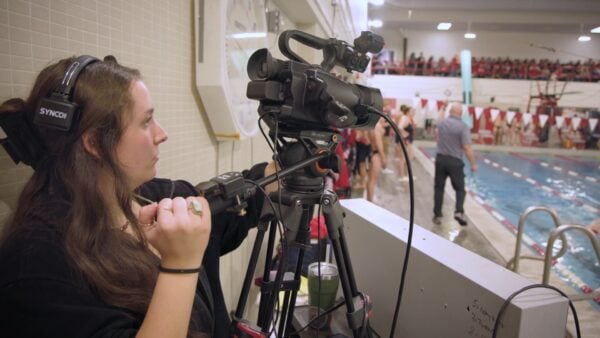
Games regularly incorporate a growing number of camera angles, student and professional commentators, music, sponsor elements, and live direction.
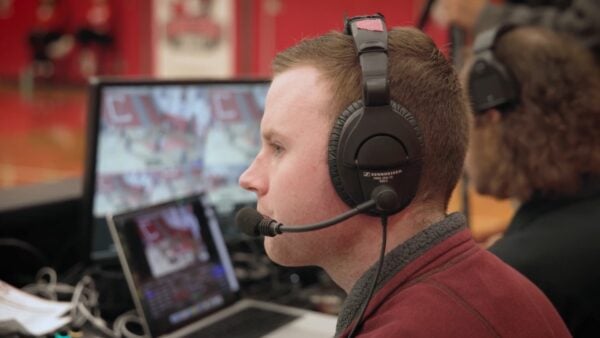
Within that environment, Ryan remains the constant — driving the graphics engine that ties the entire production together.
Every scoreboard, lower third, transition, and specialty moment is built natively inside Captivate using real-time rendering rather than pre-rendered assets. Graphics are designed to fire cleanly, stay responsive, and remain visually consistent no matter how fast the game moves or how many variables are in play.
As the production grew, the graphics had to grow with it.
That foundation now supports graphics packages across nearly every sport at Keene State — basketball, baseball, softball, hockey, soccer, volleyball, and more. And while the production scale continues to grow, the graphics remain disciplined, readable, and broadcast-safe.
What started on campus didn’t stay there.
In addition to his work at Keene State, Ryan also produces broadcast graphics for the Keene Swamp Bats, a summer collegiate baseball team competing in the NECBL. Those broadcasts must meet ESPN graphic requirements — including layout discipline, readability standards, and broadcast-safe motion — expectations that leave little room for improvisation.

Captivate handles that transition effortlessly.
Using the same platform, Ryan adapts graphics to meet ESPN formatting expectations while still applying timing, animation curves, and visual emphasis that elevate the broadcast beyond static compliance. The result is ESPN-ready graphics that feel alive, intentional, and production-grade.
Live data integration has also transformed the workflow. By connecting stat feeds directly into Captivate via XML, Ryan eliminated manual stat entry entirely. Player stats, score updates, and on-screen data elements update dynamically, reducing operator load while increasing accuracy — a critical advantage in fast-paced live environments.
Martin Testo, Keene State’s Athletic Director, sees that impact clearly.
“Ryan cares about the product more than anyone,” Testo says. “He wants our broadcasts to look professional, intentional, and ahead of the curve. Captivate gives him the flexibility to do that, and he’s taken it further than anything else we’ve seen. What he produces sets a standard — not just for our conference, but for what’s possible at this level.”
Over time, the broadcasts coming out of Keene State have become a benchmark. Other schools notice. Conference peers notice. Viewers notice. And perhaps most importantly, expectations rise. With each season, the audience expects cleaner motion, smarter graphics, and a more polished viewing experience — a standard Ryan has helped define.
That momentum is still building.
Ryan is currently testing NewBlue’s upcoming Beta Leaderboards functionality, already working inside the Captivate Designer with newly created leaderboard graphics. By validating how these data-driven layouts behave in real-world production scenarios, he’s helping shape how the next generation of live graphics will perform under pressure.
He’s also preparing to integrate instant replay into the workflow — another layer of complexity that will further elevate the broadcast. With more cameras, tighter timing, and higher viewer expectations, the graphics engine becomes even more critical.
The result isn’t just better graphics. It’s better storytelling. Better pacing. Better broadcasts.
This is what happens when Captivate isn’t treated as a template engine, but as a real-time graphics system. When someone takes the time to learn it deeply, challenge it, and trust it in real-world production environments — from campus gyms to ESPN distribution.
From Keene State to ESPN-ready broadcasts, Captivate Sport isn’t just keeping up. In the right hands, it’s raising the bar — and setting expectations that continue to climb.
For more information on NewBlue Captivate Sport, discover how live data, real-time rendering, and native graphics design power professional sports broadcasts—on campus and on ESPN platforms.
👉 Discover Captivate Sport